
The Orishas: Divinities of the Yoruba Religion and Santería
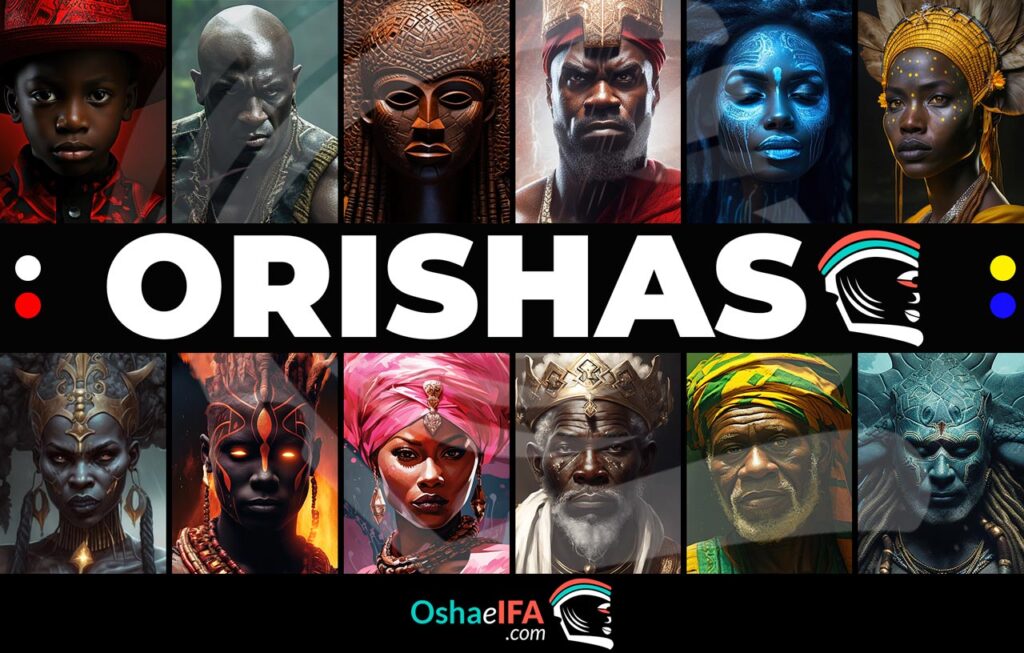
The orishas are fundamental divinities and spiritual forces in the Yoruba religion and in diaspora traditions such as the Regla de Osha-Ifá, popularly known as Cuban Santería. They are associated with forces of nature, communities, human activities, and different aspects of existence, including destiny, justice, motherhood, illness, agriculture, the sea, rivers, fire, and crossroads.
They are often called gods or saints, but neither word fully explains what they mean. The orishas are not Catholic saints, and they cannot all be understood simply as ancient human beings who were deified. Some traditions remember certain orishas as kings, heroes, founders, or ancestors; others describe them as primordial forces connected with creation and the order of the world.
This selection brings together the principal orishas venerated in the Afro-Cuban tradition, their general meanings, widely known correspondences, and links to the pages dedicated to each one. Names, attributes, colors, numbers, and forms of worship may vary across regions, branches, and religious houses.
Principal Orishas and Their Meanings
The following table presents correspondences widely known within Afro-Cuban Osha. It is not a universal standard: colors, numbers, Catholic associations, and feast days may vary according to the orisha’s path, the religious house, and the lineage.
| Orisha | Main domain | Commonly associated colors | Number | Saint associated in Cuba | Commonly associated date |
|---|---|---|---|---|---|
| Eleguá | Paths, crossroads, communication, and movement. | Red and black. | 3 and 21. | Saint Anthony of Padua or the Christ Child of Atocha, depending on the house. | June 13. |
| Oggún | Iron, tools, work, technology, and war. | Green and black. | 3 and 7. | Saint Peter. | June 29. |
| Ochosi | Hunting, precision, justice, and the pursuit of goals. | Blue and yellow. | 3 and 7. | Saint Norbert. | June 6. |
| Obatalá | Human creation, the head, clarity, peace, and order. | White. | 8. | Our Lady of Mercy. | September 24. |
| Yemayá | The sea, motherhood, protection, and the continuity of life. | Blue and white. | 7. | Our Lady of Regla. | September 7. |
| Oshún | Rivers, fertility, beauty, diplomacy, and prosperity. | Yellow and gold. | 5. | Our Lady of Charity of El Cobre. | September 8. |
| Shangó | Thunder, lightning, fire, royalty, the drum, and justice. | Red and white. | 4 and 6. | Saint Barbara. | December 4. |
| Oyá | Winds, storms, transformation, and certain domains of the dead. | Nine colors and wine tones. | 9. | Saint Teresa of Ávila or Our Lady of Candelaria, depending on the house. | February 2 or October 15. |
| Babalú Ayé | Illness, epidemics, suffering, and recovery. | Purple, white, and sackcloth tones, depending on the house. | 17. | Saint Lazarus. | December 17. |
| Agayú | The strength of the Earth, vast spaces, and intense natural forces. | Dark red and combinations of several colors. | 9. | Saint Christopher. | July 25. |
| Orunmila | The wisdom of Ifá, divination, destiny, and good counsel. | Green and yellow. | 16. | Saint Francis of Assisi. | October 4. |
| Ibeyis | Twins, childhood, good fortune, joy, and the protection of children. | Combinations of red, white, and other colors. | 2. | Saints Cosmas and Damian. | September 26. |
What Are the Orishas?
The word orisha—also written oricha, orishá, or òrìṣà—refers to different divine forces in Yoruba religious traditions. Not all orishas have the same origin, function, or scope. Some are associated with particular cities, rivers, mountains, human activities, royal lineages, or communities; others hold central roles in stories about creation and the organization of the universe.
The Yoruba religion developed among peoples historically settled in regions that today belong mainly to Nigeria, Benin, and Togo. There was no single, identical catalog of orishas for every Yoruba city: each territory could preserve its own cults, stories, and priesthoods. For this reason, a list from Ilé-Ifẹ̀, Ọ̀yọ́, Ọ̀ṣogbo, or a diaspora community may differ significantly from others.
Some stories remember certain orishas as former rulers, heroes, founders, or ancestors who attained divine status. Shangó, associated with the history of the kingdom of Ọ̀yọ́, is one of the best-known examples. Other orishas are considered primordial forces, beings that existed before humanity, or participants in the ordering of creation.
Are the Orishas Gods or Saints?
The word gods is often used in English as an approximate translation, but the category does not always capture the complexity of Yoruba cosmology. The orishas have authority, personalities, stories, cults, and particular functions, but they relate to a supreme being and to a wider network of ancestors, collective powers, and spiritual principles.
They are not Catholic saints either. In Cuba, different orishas were historically associated with Catholic images and feast days. This process produced correspondences such as Shangó with Saint Barbara, Oshún with Our Lady of Charity of El Cobre, and Yemayá with Our Lady of Regla. These associations are part of Afro-Cuban syncretism, but they do not make an orisha and a saint the same entity.
Olodumare and the Relationship Between the Supreme Being and the Orishas
The orishas do not belong to the same category as Olodumare, the name used for the supreme being and source of existence. The terms Olorun and Olofin also appear in the Yoruba religion and the Regla de Osha-Ifá, but not all sources or lineages explain these names in the same way.
In some Afro-Cuban accounts, Olodumare, Olorun, and Olofin are used to express different dimensions of supreme divinity and its relationship with creation. In other Yoruba contexts, Olodumare and Olorun may function as closely related names or titles. For this reason, it is not advisable to present them as three separate gods or as a division accepted everywhere.
The orishas participate in the order of the world, mediate in different areas of existence, and receive worship through prayers, songs, offerings, consecrations, and systems of divination. To explore this distinction further, read the article on Olodumare, Olorun, and Olofin.
Ori and Personal Destiny
Ori means “head,” but its religious meaning goes beyond the physical body. It is associated with a person’s inner identity, consciousness, personal destiny, and ability to fulfill the path chosen before birth. For this reason, Ori deserves its own explanation and should not be presented simply as another name on a conventional list of orishas.
The Orishas in the Yoruba Religion and the Regla de Osha-Ifá
The Yoruba religion and Santería are not exactly the same. The Regla de Osha-Ifá is an Afro-Cuban tradition formed through the preservation and adaptation of knowledge from different Yoruba peoples who were forcibly brought to Cuba during the slave trade. On the island, this knowledge interacted with other African traditions, Catholicism, cabildos de nación, and the social conditions of the colonial and republican periods.
In Cuba, the term Lucumí was used for many Africans and their descendants connected with the Yoruba world. The ritual language, songs, names of the orishas, and many ceremonies preserved African roots, while also developing distinctive forms within the diaspora.
The word Santería is still widely used, although many practitioners prefer Regla de Osha, Osha-Ifá, or Lucumí religion. “Santería” arose in connection with the visible presence of Catholic saints’ images, but it does not fully describe the religion’s structure or the foundations of the orishas.
How Many Orishas Are There?
There is no universal, closed list of all the orishas. The traditional expression 400+1 should not be understood as a literal count of exactly 401 deities. It expresses that they are innumerable and that there may always be another force, local cult, or manifestation.
In West Africa, different cities and communities preserved their own orishas or gave greater importance to some than to others. In Cuba, the worship of a smaller group survived and was reorganized, alongside foundations, ancestors, and spiritual powers that do not all belong to the same category.
The selection below therefore brings together the orishas best known in the Afro-Cuban context, but it is not intended as a complete list of the entire Yoruba religion.
The Four Warrior Orishas
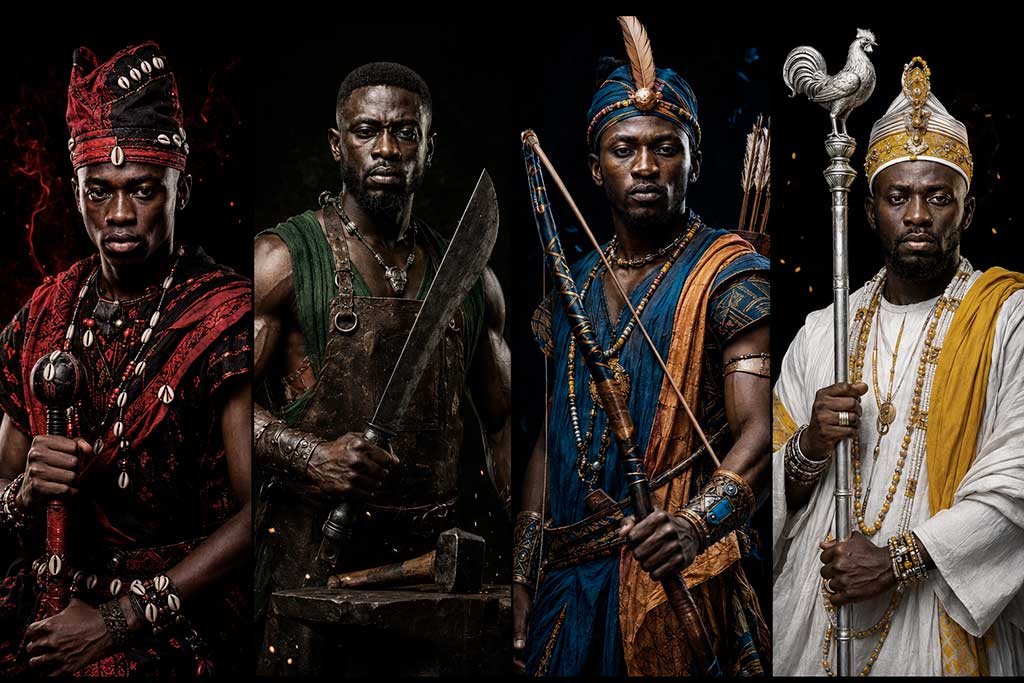
In the Regla de Osha-Ifá, Eleguá, Oggún, Ochosi, and Ozun form the group known as the four Warriors. Their foundations are associated with opening paths, work and defense, justice, vigilance, and a person’s stability.
Eleguá: Paths, Crossroads, and Communication
Eleguá governs thresholds, crossroads, decisions, and movement. He is a messenger between different planes and receives priority attention because he regulates whether a path is opened or closed. In the Afro-Cuban tradition, he holds the first place among the Warriors.
Oggún: Iron, Tools, and Transformative Work
Oggún is the orisha of iron, forging, tools, hard work, technology, and war. He represents the force that clears a path through the forest and transforms matter through discipline, technical knowledge, and effort.
Ochosi: Hunting, Precision, and Justice
Ochosi is a hunter and a knower of the forest. In the Afro-Cuban tradition, he is associated with the pursuit of goals, precision, courts, prisons, and different forms of justice. He has a particularly close relationship with Oggún.
Eleguá, Oggún, Ochosi, and Ozun make up the four Warriors. Eshu shares a close religious root with Eleguá, but is not added as an independent fifth Warrior.
Prominent Orishas in the Regla de Osha-Ifá
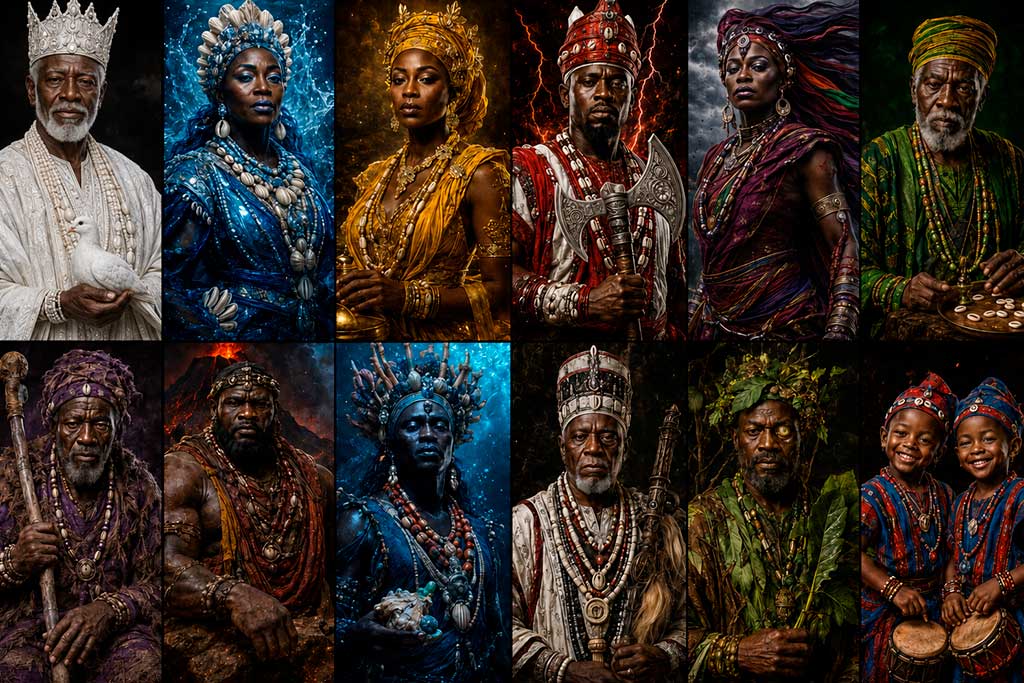
The following orishas have a prominent presence in the Afro-Cuban tradition. They do not form a universal hierarchy, nor does this mean they are all consecrated in the same way. Some may be received through Kari Osha, while others are received through particular ceremonies and foundations that depend on the orisha, branch, and lineage.
Obatalá: Human Creation, the Head, and Clarity
Obatalá is associated with the creation of the human body, the head, serenity, purity, and order. His many paths may express masculine or feminine qualities, youth, old age, authority, patience, and justice.
Yemayá: The Sea, Motherhood, and Protection
Yemayá holds a central place in Osha as a force associated with the sea, motherhood, protection, and the continuity of life. Her paths express different depths, temperaments, and relationships with the waters.
Oshún: Rivers, Fertility, and Diplomacy
Oshún is associated with rivers, fertility, beauty, sensuality, prosperity, social intelligence, and diplomacy. Her stories also show suffering, determination, political skill, and the power of negotiation.
Shangó: Thunder, Royalty, and the Drum
Shangó is associated with thunder, lightning, fire, royalty, justice, dancing, and drums. Some traditions connect him with a former ruler of Ọ̀yọ́ who attained divine status, although his religious meanings extend beyond a single historical biography.
Oyá: Wind, Storms, and Transformation
Oyá governs winds, storms, sudden changes, and transformation. In the Afro-Cuban tradition, she is also associated with the cemetery entrance and with certain domains related to the dead, without being equivalent to Egungun.
Orunmila: The Wisdom of Ifá and Knowledge of Destiny
Orunmila is the witness of creation and keeper of the wisdom of Ifá. He is associated with divination, good counsel, conduct, and knowledge of destiny. His worship has its own organization, priesthood, and ceremonies.
Babalú Ayé: Illness, Suffering, and Recovery
Babalú Ayé is associated with contagious diseases, epidemics, physical pain, exclusion, and the possibility of recovery. His worship brings together respect, fear, and compassion for those experiencing illness or suffering.
Agayú: The Strength of the Earth and Great Natural Powers
Agayú represents an immense force that is difficult to contain. In the Afro-Cuban tradition, he is often associated with the Earth, vast spaces, powerful rivers, and extremely intense natural phenomena. Some houses also associate him with volcanic imagery.
Olokun: The Depths of the Ocean and Its Mysteries
Olokun is associated with the deep sea, wealth, stability, the unknown, and what remains hidden beneath the waters. Olokun’s gender, representation, and relationship with Yemayá may be explained differently in Africa, Cuba, and other parts of the diaspora.
Oduduwa: Authority, the Earth, and the Memory of Origins
Oduduwa holds a fundamental place in stories about Ilé-Ifẹ̀, the formation of Yoruba kingdoms, and the legitimacy of different royal lineages. In the Regla de Osha-Ifá, Oduduwa also has particular foundations and meanings related to authority, creation, stability, and ancestors.
Orisha Oko: Agriculture, Harvests, and the Land’s Abundance
Orisha Oko is the divinity of agriculture, planting, and the work that produces food. He is associated with the fertility of the land, harvests, community prosperity, and the resolution of disputes.
Inle or Erinle: River, Fishing, Medicine, and Beauty
Inle, also called Erinle, is associated with the river, fishing, hunting, medicine, and knowledge of the body. In the Afro-Cuban tradition, he is regarded as a figure of great beauty and is associated with health care.
Osanyin or Ozain: Herbs and the Secrets of the Forest
Osanyin possesses knowledge of leaves, roots, bark, and the powers of plants. His presence is essential in many preparations and consecrations because plants transmit, cleanse, refresh, and sustain ashé in religious work.
Obba: Dignity, Resilience, and Stories of Marriage
Obba is a warrior orisha associated with dignity, resilience, and certain spaces connected with the dead. Afro-Cuban stories about her marriage to Shangó have popularized themes of love, sacrifice, pain, and fidelity, but they do not exhaust the complexity of her worship.
Yewá: Reserve, Discipline, and Funerary Domains
Yewá is associated with reserve, discipline, ritual purity, and certain funerary spaces. Her worship has particular rules, and she should not be reduced to chastity or an image of sadness.
Ibeyis or Jimaguas: Twins, Joy, and the Protection of Children
The Ibeyis represent the special power of twins, childhood, play, good fortune, and the ability to overcome difficulties through cooperation and intelligence. Their worship also recalls the cultural importance of multiple births in the Yoruba world.
Orunmila and the Ifá Tradition
Orunmila holds a particular position as keeper of Ifá’s wisdom and knower of destiny. The Ifá corpus is organized into 256 Odù, each accompanied by verses, stories, warnings, advice, and prescriptions transmitted by religious specialists.
In the Afro-Cuban tradition, babalawos serve as the priests of Ifá. The Mano de Orula is one of the best-known ceremonies for approaching this system, although religious paths can vary among individuals and houses.
Ifá should not be presented simply as “another orisha” on a list. It is a system of knowledge, divination, and religious transmission associated especially with Orunmila. You can consult the directory of the 256 Ifá signs to learn about its structure.
Other Orishas and Figures Venerated in the Afro-Cuban Tradition
In addition to the best-known orishas, the Regla de Osha-Ifá preserves knowledge about other divinities and figures whose worship may be less widespread, belong to particular lineages, or be received through specific ceremonies.
| Name | General domain or meaning | Article |
|---|---|---|
| Naná Burukú | Antiquity, memory, still waters, and forms of ancestral wisdom. | Learn about Naná Burukú. |
| Oshumare | Rainbow, continuity, cyclical movement, and the union of Heaven and Earth. | Learn about Oshumare. |
| Aje Shaluga | Good fortune, the flow of wealth, and material prosperity. | Learn about Aje Shaluga. |
| Oke | Mountains, elevation, stability, and the strength of high places. | Learn about Oke. |
| Ayao | A figure related to Oyá, calm, certain natural spaces, and specific traditions. | Learn about Ayao. |
| Oggue | Livestock, farm animals, and religious ties with Shangó. | Learn about Oggue. |
| Dada Igbañi | Crown, birth, ritual authority, and stories connected with Shangó. | Learn about Dada Igbañi. |
| Oroiña | Deep fire and Afro-Cuban explanations related to Agayú. | Learn about Oroiña. |
| Korikoto | Fertility, birth, and the protection of children. | Learn about Korikoto. |
| Aina | Fire and births surrounded by special circumstances. | Learn about Aina. |
| Ideú | A figure connected with Oshún, the Ibeyis, and stories of loss, reunion, and abundance. | Learn about Ideú. |
| Iroko | Sacred tree, time, permanence, and communication between different realms. | Learn about Iroko. |
| Ashikuelu | A figure known mainly through Afro-Cuban transmissions and associated with the depths of the Earth. | Learn about Ashikuelu. |
Names such as Yembó or Yemú, Abata, Bóromu, Bórosiá, and Aroni also appear in particular tratados and transmissions. Their classification, history, and relationship with other powers can vary considerably between sources and houses, so they should not be presented through absolute definitions.
Eggun, Iyami, and Other Foundations of the Tradition
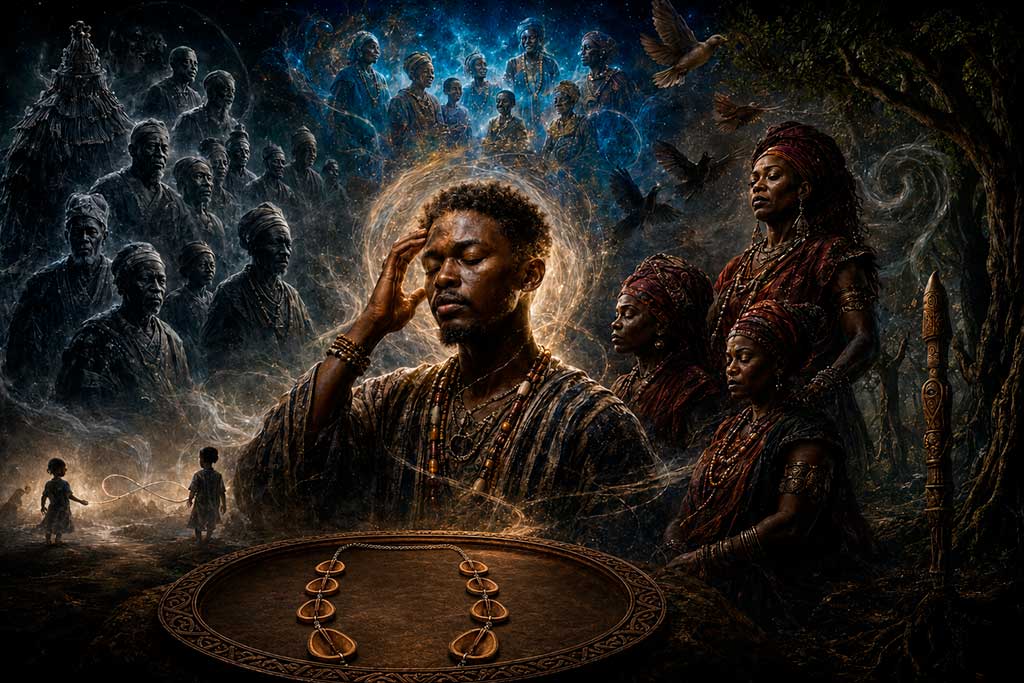
One common mistake is to place every concept, ancestor, collective, or power mentioned in the religion under the word “orisha.” Yoruba cosmology and the Regla de Osha-Ifá are broader than a catalog of individual divinities.
Egungun or Eggun
Egungun refers to the ancestors and to the ways their memory and presence participate in community life. It does not simply designate an individual orisha; it is a religious domain connected with lineage, death, and continuity between generations.
Iyami Aje or Iyami Osoronga
The Iyami represent ancestral female powers connected with creation, motherhood, social authority, knowledge, and the ability to produce or restrain destruction. Translating them only as “witches” diminishes their complexity and can reproduce sensationalized interpretations.
Egbé
Egbé may refer to a society or spiritual community associated with belonging before birth and with bonds that continue to influence life in Ayé. It should not automatically be treated as an individual orisha.
Abiku
Abiku is a traditional concept related to child spirits, cycles of birth and premature death, and an unstable presence in the world. It is a sensitive subject in cosmology, not a divinity equivalent to the principal orishas.
Oro or Orun
Oro belongs to a religious domain associated with collective ancestors, authority, and certain community mysteries. Its explanations and functions should not be confused with those of a popular orisha worshiped in the home.
Ifá
Ifá is a religious, literary, and divinatory system associated with Orunmila, the Odù, and different priesthoods. Although some explanations use personifying language, Ifá should not be reduced to another entry on a list of orishas.
How Do People Relate to the Orishas?
A relationship with the orishas is not limited to knowing colors, numbers, or images. Within religious houses, it is built through consultation, conduct, learning, songs, prayers, offerings, celebrations, and consecrations carried out under the guidance of authorized practitioners.
- Consultation. Divination systems offer guidance about problems, conduct, destiny, and necessary corrections.
- Offerings and ebo. These are made according to the consultation and the house’s customs.
- Bead necklaces or elekes. They represent religious ties and are received through ceremonies, not as simple accessories.
- The Warriors. They are received through a ritual process within a lineage.
- Kari Osha. This is the consecration through which a person’s tutelary orisha is enthroned and a new religious status is established.
- Ifá. It has its own ceremonies, foundations, and authorities within the branches that practice it.
- Patakíes and stories. They transmit memory, norms, warnings, and models of conduct.
Specific procedures depend on the branch and fall under the authority of each house. A public webpage can explain general meanings, but it does not replace consultation or religious training.
How Is a Person’s Tutelary Orisha Determined?
There are two main procedures in the Regla de Osha-Ifá. In certain Osha branches, the tutelary orisha is determined through a ceremonial consultation with the dilogún, conducted by olorishas with the authority to do so. In houses that recognize Ifá’s authority in this matter, the determination of the Guardian Angel is carried out through Orunmila and under the guidance of babalawos, commonly during the reception of the Mano de Orula—Awofaka or Ikofafun.
Each house follows the procedure transmitted through its lineage. A person’s tutelary orisha is not chosen according to personal preference or discovered through a birth date, zodiac sign, personality, or dreams.
Orishas and Catholic Saints: How Syncretism Developed
During Cuba’s colonial period, African traditions developed under conditions of slavery, prohibition, surveillance, and forced evangelization. Africans and their descendants interacted with Catholic images, feast days, confraternities, cabildos de nación, and popular practices on the island.
This process gave rise to associations between orishas and Catholic figures. Similarities could be based on colors, objects, stories, gender, feast days, or visual attributes. However, there was not always a single correspondence, and these associations changed from place to place and across lineages.
For this reason:
- Shangó is not Saint Barbara.
- Oshún is not Our Lady of Charity of El Cobre.
- Yemayá is not Our Lady of Regla.
- Babalú Ayé is not Saint Lazarus.
Catholic images are part of Afro-Cuban history, but they do not replace the religious foundations of the orisha.
The Orishas in Other Diaspora Traditions
Yoruba-derived worship developed differently in different places. The Regla de Osha-Ifá took shape in Cuba; Candomblé nations and, later, Umbanda currents developed in Brazil; Orisha traditions formed in Trinidad; and communities connected with more recent migration emerged in other countries.
Names, ritual languages, consecrations, natural associations, and relationships between divinities may differ. For example, the orixás in Umbanda should not automatically be explained using the same functions, foundations, and ceremonies as Cuban Santería.
Frequently Asked Questions About the Orishas
How many orishas are there?
There is no fixed number accepted across all regions and lineages. The expression 400+1 conveys that the orishas are innumerable. In Afro-Cuban Osha, worship is preserved for a smaller group, organized according to its own foundations.
Which orisha is the most powerful?
There is no universal ranking that places a single orisha above all others in power. Each has particular authority and functions. Olodumare belongs to a different category as the supreme being, while Eleguá receives priority attention in many ceremonies and Obatalá has a special relationship with the head and human creation.
Are the orishas gods?
The Yoruba religion recognizes Olodumare as the supreme being and the orishas as divine forces connected with creation, nature, communities, and human life. Some scholars describe this structure using categories such as monotheism, polytheism, or diffuse monotheism, but no Western label fully explains the cosmology.
Are the orishas Catholic saints?
No. Associations with saints developed through historical processes of syncretism in Cuba and elsewhere. An orisha and a saint may share an image or popular feast day, but they belong to different religions.
Were all the orishas once human beings?
No. Some traditions remember certain orishas as rulers, heroes, founders, or deified ancestors. Others are described as primordial powers, forces of nature, or participants in the ordering of creation.
Can someone honor an orisha without initiation?
A person may show respect, learn, pray, or take part as a visitor in activities permitted by a religious house. However, receiving foundations, performing ceremonies, or claiming religious authority requires the appropriate processes. Public practices do not replace initiation or the guidance of a lineage.
Continue Learning About Osha-Ifá
- Yoruba Religion. Learn about the African tradition, its cosmology, principles, and regional diversity.
- Santería or the Regla de Osha-Ifá. Discover how the Afro-Cuban tradition developed and what distinguishes it from its African roots.
- Ifá Signs. Explore the 256 Odù and the structure of the Ifá system.
- Mano de Orula. Learn about this ceremony for approaching Ifá within the Afro-Cuban tradition.
- Prayers to the Orishas. Find prayers and invocations dedicated to different divinities.
- Patakíes. Explore stories that transmit teachings, conflicts, and models of conduct.
- Orixás in Umbanda. Learn how their meaning changes within a distinct Brazilian religion.
A Diverse Tradition Between Africa and the Diaspora
The orishas are not a uniform list of figures with unchanging colors and numbers. They are part of living religious systems shaped over centuries among Yoruba cities, lineages, priesthoods, and diaspora communities. Their stories, attributes, and forms of worship preserve continuities, but also regional differences and historical transformations.
Understanding them requires distinguishing between the supreme being, the orishas, the ancestors, spiritual collectives, concepts of destiny, and systems of divination. This makes it possible to study the religion more accurately and to direct readers to a dedicated article about each figure.
Recommended Bibliography and Sources
- Abimbola, Wande. Ifá: An Exposition of Ifá Literary Corpus.
- Awolalu, J. Omosade. Yoruba Beliefs and Sacrificial Rites.
- Bascom, William. Ifa Divination: Communication Between Gods and Men in West Africa.
- Bolívar Aróstegui, Natalia. Los Orishas en Cuba.
- Brown, David H. Santería Enthroned: Art, Ritual, and Innovation in an Afro-Cuban Religion.
- Cabrera, Lydia. El Monte.
- Cros Sandoval, Mercedes. Worldview, the Orichas, and Santería.
- Idowu, E. Bolaji. Olodumare: God in Yoruba Belief.
- Lawal, Babatunde. Studies on Yoruba art, religion, and thought.
- Mason, John. Studies on the Lucumí tradition and the orishas in the diaspora.
- Olupona, Jacob K. Studies on Yoruba religion and African religions.
- Ramos, Miguel “Willie.” Research on the Regla de Osha, Afro-Cuban history, and practice.
Editorial note: The classifications and correspondences on this page are presented as general guidance. When a statement depends on a particular branch, region, or religious house, it should be understood within that context and not as a universal rule.